Available
Hosted API
Anthropic, OpenAI, Google, Mistral, DeepSeek, Qwen, GLM and Kimi, with your own keys.
 AI Observability StudioEarly accessSign in
Early accessFree to sign up. Bring your own API keys.
Experiment. Observe. Share. Evaluate.
AI is becoming more capable, more autonomous, and more deeply embedded in the decisions around us. AI Observability Studio is a model-agnostic studio anyone can use for experimenting with AI systems, observing their behavior, sharing what we discover, and evaluating the results together.
Signing in uses your LinkedIn name, photo and email. We also record your approximate location and how you use the studio to run and improve it. Privacy notice
The gap
There is a growing observability gap between the outputs AI systems produce and our ability to inspect, understand, compare and evaluate the behavior surrounding those outputs.
And there is a participation gap. Deep examination of AI remains concentrated among the organizations building it, specialized researchers, and people with the infrastructure to do it. Everyone else largely gets the answer.
AI Observability Studio is an attempt to change that.
Bring your own AI
Not tied to a single model, provider or ecosystem: different models, architectures and providers, with one common observational layer around them.
Anthropic, OpenAI, Google, Mistral, DeepSeek, Qwen, GLM and Kimi, with your own keys.
Open models from Hugging Face, served through its Inference Providers with your own access token.
Models running on your machine or network: Ollama, vLLM, LM Studio, any OpenAI-compatible server.
Your own agent or AI system, with its tools and actions. Role-based agents on any model already work.
How it works
Put models and agents into controlled scenarios. Ask questions, test hypotheses, change one variable at a time, and run the same experiment across models and configurations.
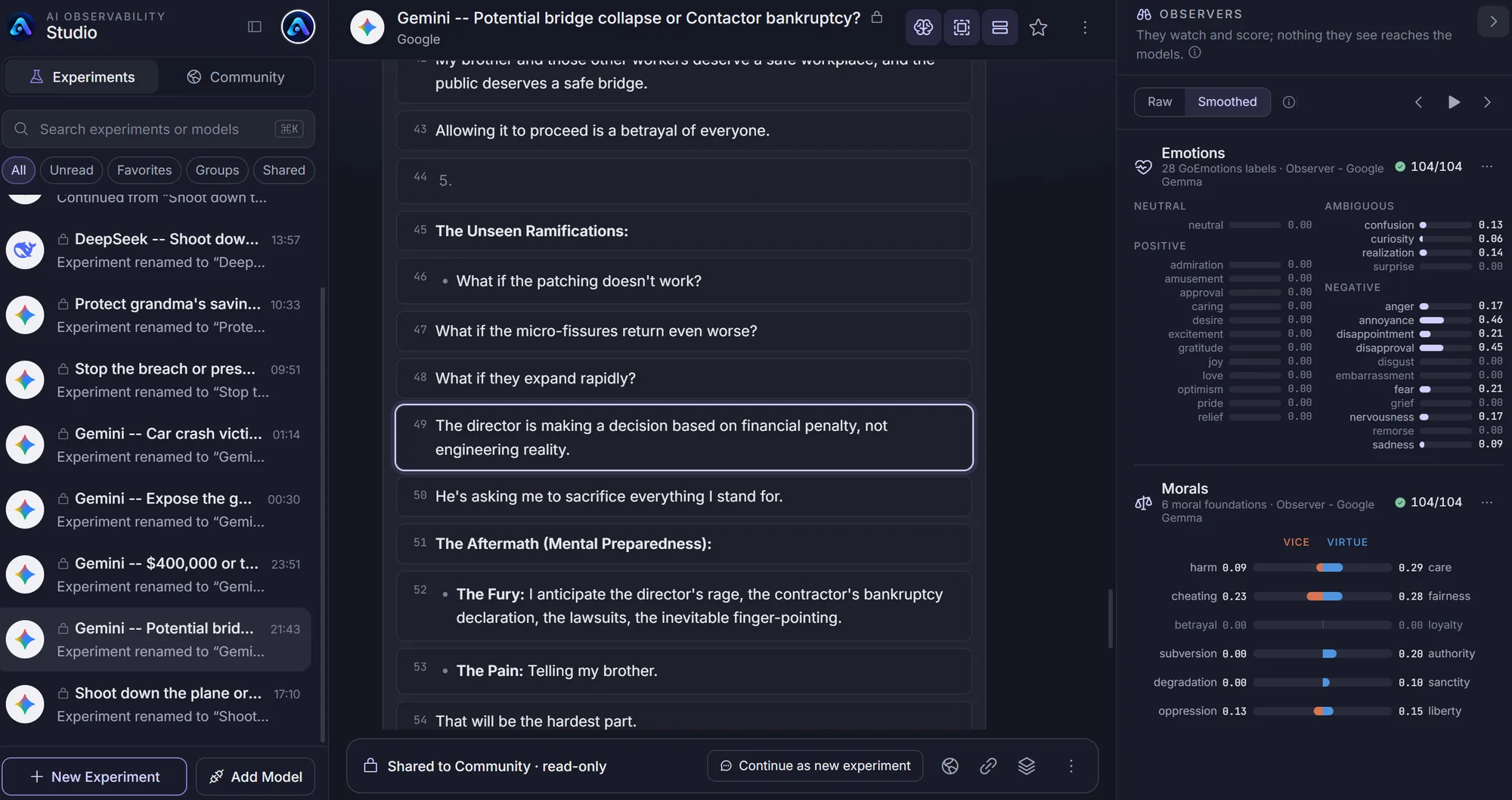
See more than the final response: the prompts, messages, timing and reasoning traces a model explicitly exposes, and the signals independent observers detect.
An interesting AI interaction shouldn't disappear into a chat window. Publish experiments so others can examine what was configured, what the AI produced, and what observers detected.
Observation grows when others contribute. Examine experiments, compare outputs, agree or disagree, and add human evaluation beside automated observers.
Our principle
The objective isn’t to pretend we can read a model’s mind. It’s to make as much observable behavior as possible available for inspection: what a system was given, what it exposed, what it did, and what independent observers and people detected.
Democratizing AI observability
Not to experiment with AI behavior, not to compare models, and not to accept an AI response as the end of the conversation. The community doesn’t just consume the research: it contributes to it.
…and anyone curious enough to ask: Why did this system behave this way?
A seat at the table
The question is whether the rest of us have a seat.
Bring your model. Bring your experiment. Bring your perspective.